Why This vs That exists
Not long ago I was following a protest movement in India that had started online after an exam-paper leak. My feed carried two completely different versions of it. One called it a conspiracy; the other, a spontaneous uprising of ordinary students. Both were confident, both were loud, and they could not both be describing the same thing.
So I went to one of the events and talked to people my own age who were actually there. The truth was messier and more human than either version online, and impossible to reduce to a side. Both feeds had shaped the conclusion for me before I had a chance to reach it myself — and I would rather see the perspectives and decide.
That is where This vs That began.
Almost every question seems to demand a winner. Which school, which technology, which treatment, which career. The format is simple; the reality rarely is. Ask an AI to compare two things and it is remarkably good at producing a smooth answer — arguments summarised, sources cited, a confident conclusion.
But that confidence bothered me.
Two credible sources may disagree because they studied different populations, used different methods, or measured different things. Two people may differ not because one is uninformed but because they value different things. Sometimes the honest answer is it depends. Sometimes the evidence genuinely conflicts. Sometimes we do not know enough. I wanted something that could say so.
How it works
A comparison is not sent to a model to be answered. It is taken apart: the dimensions it turns on, the perspectives that exist, the evidence behind each side, and where sources actually disagree — and whether that disagreement is real or dissolves once you know the context. The verdict is the result of that process rather than a paragraph someone generated.
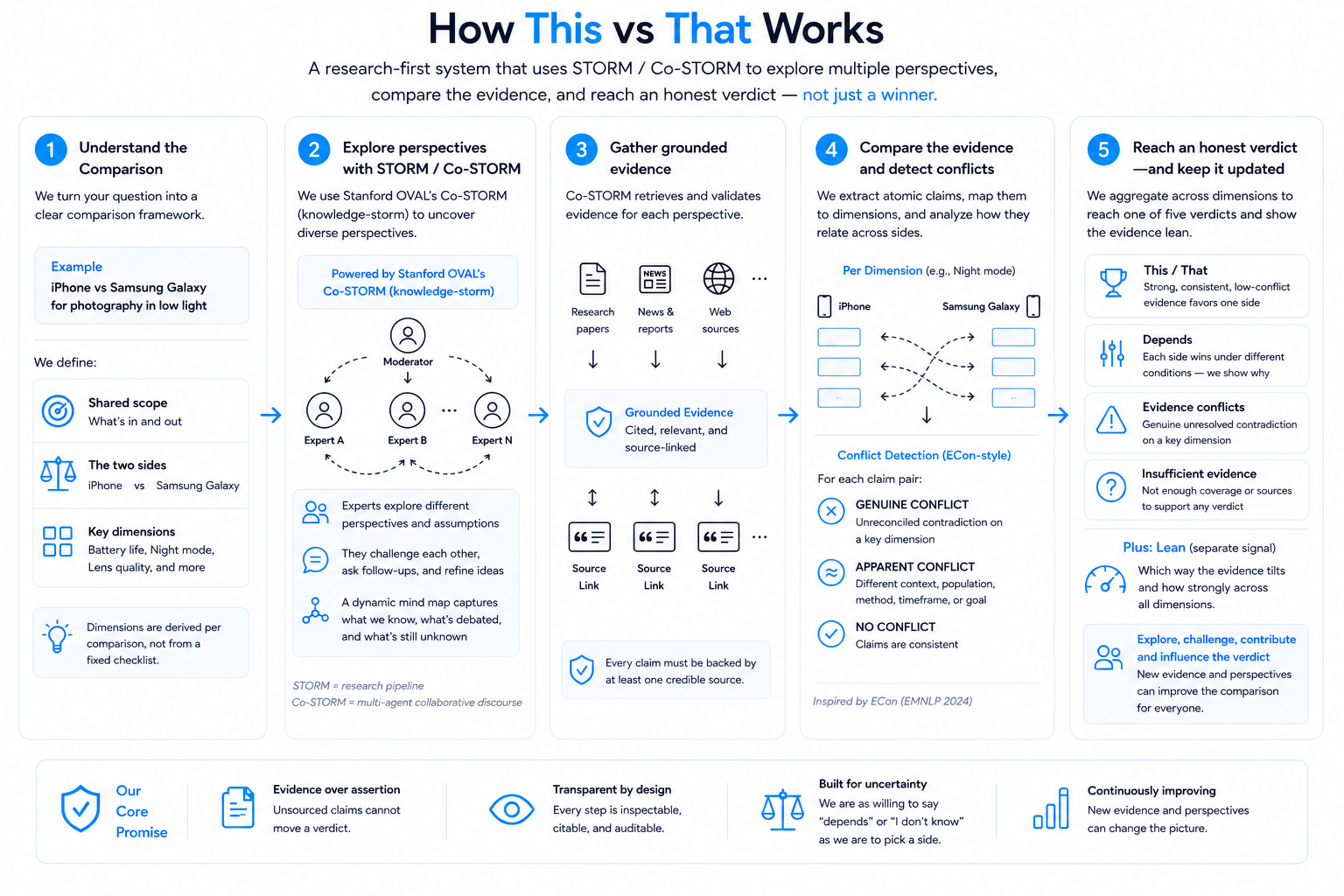
Why disagreement matters
We treat disagreement as a problem to solve: if two sources differ, one must be wrong. But disagreement is also information, so TVT preserves it instead of smoothing it away. Sometimes evidence consistently favours one side; sometimes it depends on what you care about; sometimes credible evidence conflicts and cannot yet be reconciled; sometimes there simply is not enough of it.
These are not just interface labels. They are a belief about how a system should behave around uncertainty: as willing to say it depends or I don't know as to declare a winner.
- This
- That
- Depends
- Evidence conflicts
- Insufficient evidence
Why it is personal
The hard part of AI is not generating information — there is already an enormous amount of it. The hard part is deciding what matters, which perspectives are missing, when two pieces of evidence are comparable, when disagreement is meaningful, and when to say I don't know. That is less like building a chatbot and more like building a system for reasoning.
It is also why other people can challenge it. A comparison should not become true because an AI said it first. If credible new evidence changes the picture, the comparison should change with it — so This vs That is not a machine that delivers the final answer, but a place where an answer can be examined.
What makes it different
TVT builds on research from Stanford OVAL — STORM and Co-STORM — which explores how AI systems gather knowledge through multiple perspectives and grounded conversation. Instead of turning that into one synthesised article, it constructs a comparison that keeps competing evidence visible. A typical assistant asks what is the answer? This one asks what the evidence says, why it differs, and what would change the conclusion.
TVT is a research prototype, not a system that has solved disagreement. It can miss evidence, misunderstand claims, and make mistakes; its purpose is to make those limitations visible rather than hide them behind a fluent paragraph. I built it because I think that is the direction AI should move in: not toward sounding more certain, but toward helping us understand when certainty is deserved — and when it isn't.